Posts

Showing posts with the label retirement

Paid off the Mortgage... Again!
Image
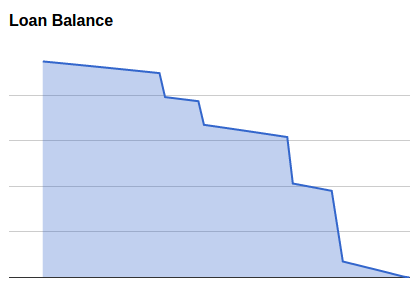
As a person who loves analyzing personal finance data , like the balance and interest paid on our mortgage, I am both excited but also sad to say we have just paid off the mortgage on our current house. We had actually paid off the mortgage on our previous home years ago, but after we bought our current residence several years ago, we decided to acquire another mortgage loan to cover some of the cost on our current, more expensive home. But now, after a few accelerated payments we have paid it off so we are again debt free.  The graph above shows the actual declining loan balance of our loan over time (pulled from a Google spreadsheet I developed) and the 4 sharp declining periods shows the 5 months when we had added large extra chunks of principal to our payments to accelerate the payoff of our loan. Two of those months are back to back (the last two) so that looks like one really big plunge where it is really two of them. Some people would therefore think I would always b...
Retirement Asset to Salary Ratio Calculator and More!

Image
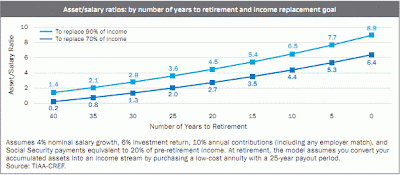
Today I received an e-mail message from my friends at TIAA-CREF who holds the bulk of my retirement assets. Included was an interesting webinar that talks about a retirement asset to salary ratio that can be used to see how well you are saving for retirement especially after stocks took the big hit in 2008/2009. When I saw that I knew it looked like an on-line calculator in the making to me, but TIAA-CREF did not have one on their site! So I knew I had to create one . First I interpolated their graph so you do not only have every 5 year increments on the retirement, but every year in between, and then I calculated the ratio for anyone who wants to enter their asset balance and salary (since dividing two numbers is so much work!) If you are going to make the 70% or 90% of salary goals I tell you, and if not I tell you now much more you need to get there. Hey, it sounded like a fun little calculator for me to write, so here it is . I also saw that Firefox 8 was just released ...

Not too bad 2010 and here's to a better 2011!

Image
With only one more day in the financial markets for 2010 it looks like the S&P 500 will end 2010 with an annual gain of about 13% to close over 1250 after starting the year a little over 1100. Whereas the 13% gain is a good number, many will still lament over the peak in 2007 when the index was near 1550. Unfortunately that will likely never occur again so it is not productive trying to figure out what return is necessary to get us back to that point (unless you just want to calculate it for fun !). If you instead look at the S&P 500 index for the past 40 years (since 1970, you will see that our current level is really not too bad. If you track the linear increase from say 1982 to 1995, if you interpolate to the end of 2010, the line would likely end lower than it currently is right now. The massive peak in 1998 to 2000 and then in 2006/2007 has skewed people's perceptions of what long term growth should really look like. I love Google Finance 's ability to generate t...

My Financial Advice - Now Open for Business

Image
Over the years I have written a ton of online financial calculators and in doing so have also doled out a lot of financial advice to people across the Internet. A lot of these people tell me I'm a lot better than the real "professionals" they have talked to and that I should go into business for myself. Well, I find it flattering, but I am not about to give up my day job at the university with one child in college and another going to be there in a few years. However, I have been doing a bit of on-line web consulting on the side, and thought why couldn't I expand that to include helping people out with simple financial advice? Since this is not my main source of income I can afford to answer the $10 question someone might have about their mortgage or their retirement plan. People will have to remember my training and experience is in system and software engineering and not finances, but I have self taught myself quite a bit about personal finances. In reality my degr...

New "Get Back" Calculator - Find the Yield Needed to Return to the "Good Old Days"

Image
I received an e-mail message today from someone looking for an online financial calculator to see what kind of return he would need on an investment to get it back to where it was in the past, before the big market slide of the past few years. Some people think if your investments go down a fixed percentage, say 20%, to get them back to where they were before you only need a 20% return, but that is not the case. You need a substantially larger percentage to increase that smaller balance back up to the value where it used to be. A drastic example is if your investment falls 50%, say your retirement portfolio falls from $400,000 to $200,000. To get back to $400K from $200K you then would need a 100% return to double that amount back up to where it was in the past. That is a pretty grim task to try to meet. So that is where my new calculator comes into play. You can either enter your fixed percentage loss, or just put your old balance and your new balance and I will calculate the bad ne...

New Personal Finance Book for the Self-Employed

Image
I just received a new book in the mail from Joseph D'Agnese and Denise Kiernan. They are both journalists who have written for the New York Times and the Wall Street Journal, and they have now written a personal finance book together specifically for the self-employed and part-timers, called The Money Book . They did interview me for parts of it, so I may be a bit biased, but after briefly skimming it, I think it is an easy to follow read that could benefit many people (not just personal finance geeks like myself). I will read the book more in depth, but upon first skim, I had to find some calculator worthy section I could use to develop some neat online tool. Therefore I have created my own Money Book calculator . This allows you to enter your monthly income and also specify how much to contribute to specific emergency, tax and retirement accounts and also all your "mandatory" monthly expenses. After entering your numbers it tells you how much you have left for discretio...

My latest calculator, Retirement Checker from Yahoo! Finance

Hey, I have not added a new online calculator to my site in a while, and since I saw this article on Yahoo! Finance , it seemed like time to add a new one . A recent study from the Journal of Financial Planning ran thousands of simluations to find the ideal retirement rates for different individuals of differing ages and income levels. It also takes into account how much the individuals already have in existing retirement savings. They came up with a large chart of figures for people to see how much they should be saving. I have taken this table and compiled it into a simple PHP calculator that anybody can use to see what their savings rate should be. Remember that the savings rate includes both what you contribute and whatever your employer might match. Try it out and see what I am talking about.

Nice Free Financial Calculator

I read in my latest copy of PC World about a really neat financial application you can download and use (now for free) called Financial Fate . It runs under any Windows platform and analyzes all your accounts and expenses and projects how you will end up in a long term scenario. It is quite comprehensive and allows you to change numbers for various "what if" scenarios to project your net worth for years to come. The company used to sell it for $69.95 but now it is completely free. So now the only question is how this company will make any money from this very useful software.