Posts

Showing posts with the label college

Washington University COVID-19 student graph Fall 2021 vs Fall 2020

Image
Orange= Fall 2020, Blue - Fall 2021 Today was the final day of class, so we have successfully completed another semester during the pandemic here at Washington University in St. Louis . Since the campus COVID-19 dashboard was updated today with final numbers for the semester, I have decided to create a graph that compares the student positive count from Fall 2020 to Fall 2021. The orange line shows last semester, and the blue line shows this semester. For Fall 2020 we ended a slightly abbreviated semester with 273 total student cases over the 95 days from the beginning to the end of classes. For Fall 2021 we only had 175 total positive cases, so we had a reduction of about 36% over 102 days. The total number of positive faculty and staff cases also dropped significantly, from 120 last fall to only 78 this fall (a very similar 35% decrease.) Last Fall the university did require masking when in any public indoor spaces, and that continued again this year when a lot more people were pres...

Washington University COVID-19 Graph, Spring 2021

Image
  Commencement was yesterday on-campus at Washington University in St. Louis so the semester and school year are officially finished. On our COVID-19 dashboard the final date was May 12, and at that point we had 602 positive student cases (504 undergraduate and 98 graduate students) and 208 positive faculty and staff cases for the full academic year (since September.) My graph above shows the positives with the students combined as the orange line on top and the faculty and staff on the bottom in blue.  Since we have 7100 full-time undergraduate students and 6600 full-time graduate students for the academic year, that comes out to about 7.1% of our undergraduates and about 1.5% of our graduate students being positive at some point during the year. The large difference is probably due to our undergraduate population primarily living on campus and congregating together whereas the graduate population lives on their own and most likely interacts with much smaller groups of frie...

Washington University COVID-19 Graph, Fall 2020

Image
  Happy New Year! The year 2020 is thankfully over and we can all look forward to a brighter 2021 when we can all get vaccinated and things will start going back to some form of "normal". The Fall semester at Washington University has ended and Spring semester does not start again until the last week of January.  During the fall, I was tracking the total reported positive cases off of the university's dashboard and was happy to see how well we were keeping the spread at bay at first. Within our population of over 7,000 on campus undergraduate students and nearly as many graduate students, we stayed under 100 total positive student cases through all of September and October (our classes started September 14.) In my graph the total student positive cases is in orange and the total faculty and staff numbers are in blue.  In the middle of November, as the temperatures turned colder and students spent more time inside, our positive numbers spiked, doubling from 95 on Novembe...

Fall 2020 Semester at Washington University: The COVID-19 Version

Image
  We have successfully completed two weeks of classes now at Washington University , but the fall semester is definitely quite different than it was last year. Even strolling across campus, the large groups of walking students have now disappeared even between classes when you just see a few students walking around and never in groups larger than two or three. Everyone is properly wearing their masks and after two weeks, the university is showing very low numbers on our COVID-19 dashboard , even though they are making it very hard to even find. Since August 31 they have run 7,477 tests on students and only have found 12 positive cases. I had thought SLU (Saint Louis University) had been doing pretty well themselves with their much more informative dashboard , with only 136 positive cases since August 31, and only 12 positives in the past 10 days out of 642 tests (Sept 14-23). One thing that really looks odd when you walk around campus is seeing all the random lone chairs placed all...

New Rain/Snow/Sun Free Path from Skinker Metrolink Station to Brookings Hall

Image
Last week the new east end garage opened on Danforth Campus of Washington University in St. Louis which was great for all the people who want to park there. But for those of us who take the Metrolink to and from campus, there is now a wonderful almost fully precipitation free path to get from the Skinker Metrolink Station to Brookings Hall (or Scott Rudolph Hall.) The map above shows the path, but it is not all on the same level so it needs some explanation. Green Hall Doorway - WashU ID required The first part is easy, getting from the Metrolink station to the archway of Green Hall. Then you enter the double doors there, but realize you need a WashU ID to enter those doors. Withou a valid ID, you must walk around to Brauer Hall where the center double entry doors are always unlocked. Luckily part of that outdoor path around Brauer Hall is even covered so you would hardly get wet if it were raining. Green Hall hallway towards Brauer You then keep walking through Green ...

Switching from HMO/EPO to HDHP Health Insurance

Image
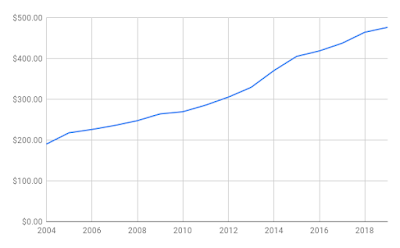
WUSTL Family HMO Premiums 2004-2019 It is open enrollment time at good old Washington University , and for the first time I have switched from the HMO/EPO choice we have been using forever to the HDHP (high deductible health plan) that the university is offering and obviously pushing. The university is even contributing $800 each year to our HSA for the family plan ($400 for single plans), and with the EPO premiums now about 3.5 times the HDHP premiums ($475.79 vs $136.89) we decided it was time to switch.  Since I have been with the university over 15 years and they now store all our old paystubs on line, it was easy for me to extract the data to see how the family HMO premiums have increased over time. Back in 2004, the HMO premiums were only $189.75 per month which was less than 5% of my gross salary. For 2019 the $475.79 represents a 150% increase whereas my university salary has only increased about 70% over those 15 years. This now represents  almost 7% of my sa...

No Exit! - Summer 2018 at Washington University in St. Louis

Image
No Exit! Just try leaving our building! We are lucky that most of the students, faculty and staff at Washington University in St. Louis are very bright, motivated individuals. Otherwise they would never be able to navigate around the east end of campus this summer to get where they need to go. This summer the east end is truly a mess with both ends of Brookings Hall being closed off, as well as the area just north of the Brown School of Social Work as well of the area south of our building, Scott Rudolph Hall , which just a few weeks ago was still a lovely landscaped area. Just last week I heard a terrible noise outside my window and saw an earth moving construction vehicle ripping up the concrete sidewalks next to our building. Scene from Rudolph Hall, May 25, 2018 - One Week after Commencement So now we only have one fully available entrance/exit to our building, the door to the west leading to Compton and Crow ( Physics ) so we must plan our trips across campus carefu...

St. Louis Metrolink Eclipse Guide - August 21, 2017

Image
Yesterday I received a phone call from a fellow Washington University employee who worked at West Campus asking what was the best way to watch next Monday's eclipse since he was coming in to work that day. The university is actually sponsoring an Eclipse watch event on our campus (with ice cream), but unfortunately none of our campus is within the range for totality so it would only be a partial eclipse party. Our campus further west is extremely close to the edge of totality so the West Campus employee was asking if he could just walk across the street and down the block to see the full total eclipse. I told him he could, but he would likely only experience a few fleeting instances of totality and it would be better for him if he could get further south and possibly further west for a better experience. However, since West Campus is located very close to the Forsyth Metrolink station and all employees can receive a free Metro U-Pass, I realized the easy solution. Hop on th...

Goodbye Giants Trees on Brookings Drive at Washington University!

Image
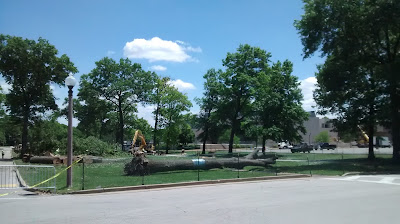
We have known for a long time that the construction was going to begin here on the east end of the Washington University campus, but it is still sad to see all the tall, huge trees along Brookings Drive disappear.  Starting on Tuesday they have been cutting them down and the canopy of green in front of Brookings Hall is quickly disappearing. Here is a time lapsed animated GIF taken from a camera we set up in our building . Refresh the page or click on the image to see the time loop again: With the east construction and east parking lots gone, everyone from our building is now parking in the Millbrook lots and walking to our building from there. Unfortunately, the construction in the middle of campus is blocking the pathway in front of chemistry (Louderman) so the best route is to walk along Throop and take the detour north of Throop that heads down near Forest Park Parkway, and then follow Throop to our building (taking the pathway between Urbauer and Compton ...

Washington University Tops Another National Ranking!

Image
Median Household Income of Selected Colleges and Universities I was pretty intrigued when a new study appeared last week which highlighted Washington University in a not so great light, but I was a bit surprised how local journalists analyzed the results. An article in the New York Times first reported on the new study which puts Wash U at the very top of colleges where the top 1% (in terms of income) outrepresent the bottom 60% in household income. The numbers are based on some older data, but in the article 21.7% of Wash U students come from the top 1% ($630K+ income) compared to only 6.1% from the bottom 60% (<$65K.) The Wash U administration uses these numbers to pat themselves on the back and boast how in just four years they are projected to more than double that 6.1% number to 13% (still a pretty paltry figure.) But what both recent Post Dispatch and Student Life articles tend to do is focus too much at the top and bottom of the socioeconomic data, and skip the much ...

Interesting Statistics on Missouri Medical School Admissions

Image
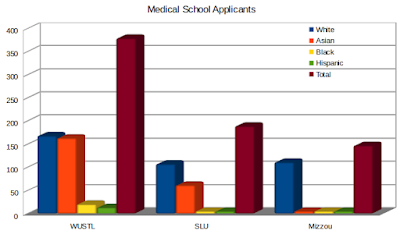
The recent article on the medical school at the University of Missouri-Columbia possibly losing its accreditation, made me curious of the demographics of the current medical students at the four medical schools within the state, and also prospective undergraduates who may be applying to the schools. Some quick Google searches led me to a bunch of interesting tables at the Association of American Medical Colleges  which shed some light to the diversity of medical students in Missouri. The first thing I noticed on the AAMC site was some tables of the racial breakdown of students from various undergraduate programs who apply to medical colleges. In Missouri, there is only one undergrad program that produces 15 or more African-American graduates that apply to med school, Washington University with 20. There are, in fact, only three undergrad programs in Missouri that produce more than 100 Caucasian-American med school applicants. Below I have a table I compiled of medical school ...